“ALL POETRY IS INCEL” latest blog offering, in progress
PART ONE: GLP1 AGONISTES (WHY, WHY, WHY, DELILAH?)
When people talk about witch trials they will tend to evoke the medieval period, or worse the “Dark Ages” when “humanity” (or at least those on the Western side of Europe, and furthest from West Asia) fell hopelessly to ignorance and superstition after the fall of that great civilisation of Rome. Indeed, at the pub after Onrie Radovic’s (excellent) exhibition at Minerva at the end of last year a poor, unsuspecting man used the term “The Dark Ages” in exactly that way in a conversation with me, and I was confronted with the truth of all the memes that talk about how men are always thinking about the Roman Empire. I queried him on what he actually imagined to be so “dark”, and he mentioned superstition and Christianity, to which I replied that it was the Roman Empire that actually spread Christianity, hence “the Roman Catholic Church”. (I was, at the time, dressed colourfully enough to believe myself to be “passing”, in a yellow top with black crochet overlaid and a long colourful patchwork print skirt, and yet shortly after this conversation, another man immediately clocked my leanings when boasting of his Transylvanian heritage, such that it seems that it would be reasonable for anyone to have judged that I might have some skin in the game concerning “the Dark Ages”).

After I had made my point about the imperialism of a world view that turns European indigenous cultural practice and knowledge into something from a backward time that we should be embarrassed of, he turned to me thoughtfully and told me “I like talking to you it makes me feel... stupid”, in a way that came across as disarmingly charming. There is something very sexy and masculine about a man who is confident enough in himself that he is unafraid to confront what he does not know. But woe betide the man that uses the expression “the Dark Ages” pejoratively in my presence and is unmoved by my counterarguments (Radovic’s immediate response to me relaying the exchange: “he had no idea who he was dealing with”). Nonetheless, when the same man came to compare himself to the aforementioned vampire, he simply assumed that I was interested in the latter because of his superior looks, which was very weird and off-putting. I don’t think anyone I know would be remotely surprised if I chose the weirdest of goths over the handsomest of men (I think about the Roman Empire a lot as well). And any difference in physical appeal was negligible, and any greater attraction I felt exclusively came down to the difference between someone talking at me and someone taking the time to read me. Does this mean that women are actually more attracted to men who are more manipulative? Probably. But I am possibly the worst case study that womankind has ever produced in practically every sense.
I thought of this encounter whilst reading a study on incel psychology that found, contrary to media speculation, men who identified as such were likely to have lower standards for a partner then the rest of the population; and also that all men imagine women to have higher standards regarding men’s looks than they actually do (hilarious and strangely obvious), and lower standards regarding things like “kindness and understanding”.1 But I mention all of this, because, once again, I find myself attempting to write about something seemingly very contemporary, i.e. the “viral” phenomenon of “incel” language, and instead writing about the cultural construction of Modernity (by which I mean the period beginning in the 15th century) and therefore this Imperialist logic we all seem to be continually oppressed by. Martin Luther’s Protestant Reformation in Germany was expressly opposed to any sexuality that it found “unproductive” (making the sexuality of older women a subject of ridicule, for example), where it had become godly to reproduce for the glory of the fatherland. Before this time, i.e. during the “Dark Ages” there was markedly less of an organised system by which to put an end to witchcraft, i.e. the mass torture, rape and murder women for practicing traditional empirical sciences, or otherwise deviating from the norm. Which is why I would place not misogyny itself (where woman have been property throughout most of European history), but an instrumentalised misogyny, firmly in the modern period. I specifically mention the case of Germany, because it was the site of a quarter of the European witch trials (and the fervour spread throughout Protestant and Catholic aligned territories) as the appropriate roles for women were assigned through a campaign of terror, where these “trials” claimed the lives of at least (and conservatively) 20,000 women from 1560-1660,2 which, I think means that just under 4 women per week, were murdered by agents of the state over the period of 100 years (in a population of around 13 million).
A couple of years ago I was relaying to a friend how funny I found an interview on Novara Media between journalist Ash Sarkar and expert in the field of incels, William Cosgrove, because said expert was so disarmingly charming that Sarkar was almost blushing. He asserted that perhaps men that were having a hard time could actually use a form of coaching that was respectful to women unlike “pick-up artistry” and then basically, and apparently totally inadvertently laid out the prospectus. He achieved this by listening to Sarkar (weird). There was a moment in which he said that it would make sense that “incels” were very mad when she self-described as “femcel” as she is a very attractive woman, in such a no-nonsense way as to make it sound objective fact (as it may well be). He thereafter continuously affirmed her insights and her experience whilst respectfully disagreeing with her. He did this seamlessly, to the extent that even I thought there might be something to his assertion of the “transactional” nature of relationships, and was glad that Sarkar could remain incensed by the assertion, as a good Communist, even in the midst of such a congenial conversation. The friend I was explaining all this to almost exasperatedly replied that only I could be watching that interview and have that as the takeaway. So I will take it under advisement. And aside from my moderately creepy parasocial enjoyment, there are some insights that seem very important; such that the fact that despite what people perceive, a significant proportion of “incels” are actually men of colour,3 and there is strong evidence that racism plays a large role in their marginalisation. Like, the media have even managed to colonise and erase the experience of incels of colour. I should point out, that having become moderately interested in this field of discourse, I have read a lot of statistics such as that less than 10% of self-identified incels engage in “misogynistic online-hostility”4, and that “38.85% of the incel participants were right-leaning, 44.70% were left-leaning, and 17.47% were centrist”5, making the media hysteria on the subject even more suspicious, in my opinion.
Another point that stayed with me from the interview, was Cosgrove’s assertion that there have always been large groups of sexless men that have tended to cause trouble in society, to such a degree that there is a term for it in Evolutionary Psychology; “Young Male Syndrome”; and that these men once would have been sent on Viking raids, or off to war, or to the monasteries.6 Apparently, there is increasingly more evidence for “Young Male Syndrome”;7 I am personally fairly wary of the field of “Evolutionary Psychology” (I feel like many of my reasons for this are actually evident in the name itself)(I am natively hostile to everything related to biological determinism, which I will write about further later in the series). And I also think there are some counterarguments to be made on such a sweeping view of history, that would blithely state that there are and have always been large numbers of men that should be simply sent off to die because they are surplus to civil society. There are Viking burial grounds in parts of England where as many as half of the warriors are women, for one example.8 But there is a kernel of truth in it, that I am quite interested in teasing out. And I think it comes down to the world view in which such a statement may be made, the premises of their being any form of life that is useless, or worthless, which seems essentially modern, and which I take exception to (notwithstanding my personal feelings regarding certain individuals, lol).
Why I suspect this has something to do with modernity, as usual, where I am concerned, has to do with what Karl Marx termed “primitive accumulation”, which he describes thus:
“...the historical movement which changes the producers into wage-workers, appears, on the one hand, as their emancipation from serfdom and from the fetters of the guilds, and this side alone exists for our bourgeois historians. But, on the other hand, these new freedmen became sellers of themselves only after they had been robbed of all their own means of production, and of all the guarantees of existence afforded by the old feudal arrangements. And the history of this, their expropriation, is written in the annals of mankind in letters of blood and fire.”9
...but which also is precedented in Protestant theology. The (at least ideally) volcel (or rather, ideally volcel and/or super gay) arrangements of the monasteries and convents were, after all, dissolved so that there would be more men and women to repopulate the fatherland. In reality, there were of course other worldly factors, such as the invention of printing press, which would have had a role in their demise, as the illumination of manuscripts had hitherto been a very profitable industry for religious orders (making books extremely valuable), until they became so easily reproduced, thus making the workforce of the orders essentially redundant. There are usually material economic rationalisations for everything. In the 100 year period of the operation of the Dutch East India Company, which was supposed to have generated massive profits, the Dutch population actually stagnated, apparently partly because (conservatively) 1 in 3 Dutch sailors would never return from their journeys.10 Such that the Protestant ethic was very much in force, where men and women would be set to work repopulating the wealthy shareholders with children who would grow up to be (sometimes literal) cannon fodder. Obviously, there have always been lives deemed to have been of little value, slavery has existed for thousands of years, soldiers of inferior skill have always been set upon strongholds during sieges in order to starve those resisting. But I think this exact form of rationalisation is a product of the modern world view. Indeed, before the term “cannon fodder” there was “food for powder”, as expressed by Falstaff, in William Shakespeare’s Henry IV Part I (1598), of his army he earlier describes as: “the cankers of a calm world and a long peace”. Falstaff is, of course, a comic figure, and the extended description of his army of “pitiful rascals” is funny because it is ridiculous.11 Among the fray as described are “younger sons to younger brothers”12, because, you know, armies used to be ideally comprised of the best of noblemen, and shit. Instead of people who have few options fighting on behalf of the ruling class in asymmetric warfare against the world’s poorest. No one wants to be treated like they are worthless, and so we deny people who feel worthless even their feelings on how we have treated them, and then try to make out that they’re dangerous.
My own recent marginalisation has presaged another relapse of Myalgic Encephalomyelitis, where I am barely able to move or to think, and am constantly in pain. I have always hidden it as best I could, which was apparently pretty well. But for the longest time I thought couldn’t get a job using my intelligence because people knew how difficult it was for me to read. Of course, it never meant me reading less than other academics, and it was rare that anyone would figure out how bad it is unless they actually lived or worked beside me. And it seems now more like I probably couldn’t get a job because I might ask too many questions, and I might cause trouble. But then, it seems like most of the smartest people I know work quite stupid jobs because intelligence is basically surplus to requirement in this society. I don’t think that any life is worthless, but I disdain those who put themselves above others. But, whatever my values, the things one says to oneself in the middle of the night, assessing myriad failures, are another story. I have always believed myself to be worthless as a partner, because I can never tell when I am not going to be able to get up, and because I could never get a real job, and I would never be able to contribute to the two-income household necessary to family life under capitalism (which at this point almost has the character of hyperstition, to borrow Nick Land’s stupid term). As a bedridden teenager, I used to think that in another time, people like me would have been just left out in the cold to die. I thought I was selfish, always to persist. I don’t think I could have been any more wrong in this internalised ableism. The ideology, always an undercurrent in our society, that I describe, is fascism. And, in the end, I probably have quite a lot to contribute that will probably never earn me anything like a living, lol. I feel totally worn out by this notion of worth tied to social status in a society that seems to privilege the most craven behaviours. So fuck “disability awareness” in place of safe and secure housing, and not having to work myself half to death, until the ghoul of chronic illness finishes me off. There is nothing so dangerous to health as stress and no stress as encompassing as financial stress. But now I am wondering if I haven’t developed a case of Young Male Syndrome, and how to organise so that we actually are a problem, because fuck the way things are.
When I started writing this months ago, a treatise on the pop-cultural phenomena of incel vernacular (of which I am quite enamoured) and the debasement of aesthetic theory that is prevalent in media coverage of “Looksmaxxing” (what the fuck is “beauty?”), which I have decided is much more dangerous than Looksmaxxing itself. What was almost a flash-in-the-pan of excellent memes regarding contortions of language for which the “manosphere” were responsible, was a reminder of the power of invention… in a deadened world watching multiple screens where the cues from ominous music, and stupid, formulaic scripts riddled with exposition (so you can keep scrolling while you watch) that everything is stated to the degree that nothing is said. In an interview with comedian Adam Friedland, the most famous of the Looksmaxxers: Clavicular, spoke of the efficacy of GLP-1 Agonists, the class of weightloss drugs to which Ozempic belongs, because thinness all-important to this version of beauty (which, in being racist to the extent of phrenology, in no way deviates from the mainstream). I think about the poet John Milton who wrote “Samson Agonistes”, following his famed “Paradise Lost”, which went on to inspire revolutionaries across the globe as explained by a new book by academic Orlando Reade (What in Me Is Dark: The Revolutionary Afterlife of Paradise Lost). In many ways it is another story of Modernity, with Milton’s ties to the English Civil War and the establishment of British Parliamentary Democracy. His writing is also shockingly misogynistic, brimming with rejection, to the extent that the story of Samson and Delilah would have obvious (and cringeworthy) appeal.
At the end of the American Empire, seemingly all we are allowed to hear about is white men and their loneliness. But I don’t believe that this is something limited to white men or that viewing the world in terms of transactional relationships and use-value is in any way fringe. I am tired of the male loneliness epidemic being cast as separate from the loneliness epidemic, as though we must now all be lonely in our loneliness except for men, who are necessarily entitled to something more. And it is the media that engineers this polarisation, such that I think the only appropriate response is solidarity. The agony of all of this is so palpably universal, the fear and sadness that threatens to take us all under.
And our art institutions have proven totally incapable of meeting the moment, interested solely in positive representation, while they sweep away connections to donors actively making things worse for ordinary people, donors who make their money off of problem gambling, donors who use our public institutions to launder the reputation of a foreign power currently committing genocide. Hany Armanious’ excellent exhibition at the Museum of Contemporary Art feels like a miracle or a mirage. And yet, the museum director made some bizarre comment on Hany’s work being good for not being “polarising” as though strong formal properties somehow preclude the political, because the political can only be a statement without nuance, the absolute correct way to view things and express them, the humourless, miserable, output of the Liberal thought police. Reading about the camaraderie of incels, it’s hard not to imagine that I have pulled myself out of the same thing in the arts:
“Alternatively, incel identity provides a sense of fraternity (Crimando, 2019), virtuous victimhood identity (Ok et al., 2021), a common enemy (Lindsay, 2022), and a rich lexicon of humorous in-g(roup terminology (Gothard, 2020). It may be preferable for many incels to reinforce their incel identity than to participate in what they perceive as an anxiety inducing mating market (Costello, 2020).”13
I have lost all pleasure that I once derived from this self-styled “world” of art, and I began to abandon it toward more solitary literary pursuits for the sake of sanity. To have something, finally, that is just my own, to stop giving it all away, which is something that, in itself, people seem to hate me for… “From each according to his ability, to each according to his needs.” I change my mind, and will continue to bury your medicine in your steady diet of gossip, my faithless hounds. But still, I hate to think of the energy that I have wasted when I look at what is now on offer in our Institutions. But it is evident, that in this, at least, I am not alone. And this loss of pleasure in things, hallmark of depression, is also a phenomenon that actually bears closer inspection, as even bad art will tend to mirror life. I suppose then, that the presence of the GLP-1 Agonist weightloss drug, which quite literally works by suppressing pleasure (that tied to eating but everything else as well)14 becomes a metaphor for the present moment, and the valourisation of misery that seems to encapsulate the ruling class. “Why, why, why, Delilah?”
1 William Costello, Vania Rolon, Andrew G. Thomas & David P. Schmitt (2023): The Mating Psychology of Incels (Involuntary Celibates): Misfortunes, Misperceptions, and Misrepresentations, The Journal of Sex Research, DOI: 10.1080/00224499.2023.2248096 To link to this article: https://doi.org/10.1080/00224499.2023.2248096 Page 21
2 Bengt Ankerloo, William Monter, & Stuart Clark, “Three-quarters German? European Witch Trials 1560—1660”. In Witchcraft and Magic in Europe, Volume 4, (Bloomsbury Publishing, 2001).
3“The Truth About Incels | Ash Sarkar meets William Costello”, Novara Media, May 20, 2024,
4 Cosgrove, Rolon, Thomas, Schmidt ibid., p.6
5 https://liberalarts.utexas.edu/news/incels-are-not-particularly-right-wing-or-white-but-they-are-extremely-depressed-anxious-and-lonely-according-to-new-research
6 Cosgrove, Sarkar, ibid. “...sexless young men typically throughout history throughout time have been the group to worry about so strongly associated with violence, that we call it the Young Male Syndrome in our field, that this has always been a huge huge problem now throughout history you had kind of cultural or social institutions to deal with your population of incels so for example the monastery the monastery would be one for sure give a high status position to kind of channel these extra guys into you’d create Vikings out of them the Vikings were likely incels not not the sexy kind of Netflix Vikings that you think from the TV shows uh the Portuguese explorers there’s strong evidence that they were incels basically sent on purpose missions to kind of basically get away from causing trouble around the for everyone else.” 19:19
7 Cosgrove, Rolon, Thomas, Schmidt ibid., p.25
8 https://www.thevintagenews.com/2015/10/03/better-identification-of-viking-corpses-reveals-half-of-the-warriors-were-female/
9 Karl Marx. Capital Volume One, Part VIII: Primitive Accumulation, Chapter Twenty-Six: The Secret of Primitive Accumulation, https://www.marxists.org/archive/marx/works/1867-c1/ch26.htm
10 Hochstrasser, J. (2007). Still life and trade in the Dutch golden age. Yale University Press p.256
11 William Shakespeare, Henry IV, Act 4, Scene 2, line 65.
12 William Shakespeare, Henry IV, Act 4, Scene 2, line 28-29.
13 Cosgrove, Rolon, Thomas, Schmidt ibid., p.27
14 I do not mean that these drugs are not medically effective, as they seem to be effective for a lot of conditions outside weightloss. I also have no judgement on anyone taking them for purely aesthetic reasons. That said, I know some people who have taken them who have had terrible side effects. I have no comment to make on anything medical, except that, as someone who lived with comorbid chronic conditions that mostly effect women, I really fucking hate doctors, lol. I comment on the GLP-1 Agonist because it is an awesome name and also because I simply love the idea of the suppression of pleasure, for I am something of a vampire.

(Buy me a coffee link where you can literally buy me a coffee for this post if you have a mind to support, thanks!)
PART 2: GOONING FOR GODOT
Between the media frenzy regarding the “manosphere”, and what seems like an upsurge in violence towards women in the city that I live in (the horrific ordinariness of the intimate partner violence statistics,1 combined with two recent gang rapes of teenage girls by boys from private schools)2, I have found myself again wondering what exactly the difference between a man and a woman is supposed to be, that would justify this dehumanisation. Thinking around this again, “what is a woman”, I am reminded of a story beloved by internet edgelords, where in reply to Plato’s definition of a man as being a “featherless biped”, Diogenes famously countered by raising a (pre-prepared) plucked chicken and shouting “behold—a man”. In my youth, and after and in-between years of abuse by a medical system that barely studied or acknowledged health conditions predominately experienced by women, I can recall being mystified by the stupidity of the notion of the male body as standard, writing a throwaway line somewhere; “our doctors just assumed you were a woman with an outie”, which is, incidentally, a reasonably accurate description of how the penis is formed in utero. Based on my own experience, I would say that men are basically just like me except less witty, and that if I find them quite sexy, it is most likely based on my innate and very womanly sense of pity for the poor creatures. But basically whilst thinking around this subject, I keep having the same vision as that of one Julian of Norwich (1343-after 1416) of Jesus’s side wound:
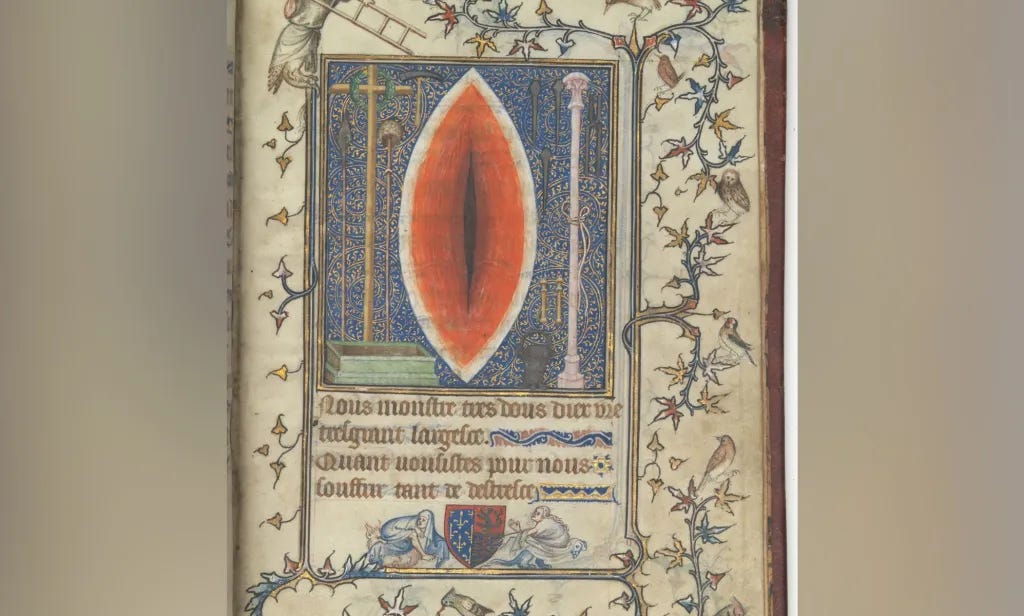
Wound of Jesus Christ from the Psalter and Prayer book of Bonne de Luxembourg, ca 1345. (Fine Art Images/Heritage Images/Getty)
“THEN with a glad cheer our Lord looked unto His Side and beheld, rejoicing. With His sweet looking He led forth the understanding of His creature by the same wound into His Side within. And then he shewed a fair, delectable place, and large enough for all mankind that shall be saved to rest in peace and in love.87 And therewith He brought to mind His dearworthy blood and precious water which he let pour all out for love. And with the sweet beholding He shewed His blessed heart even cloven in two.”3
Julian would also have visions of Jesus lactating, and verily I imagine her lifting a doll-sized Jesus on the cross, replete with vaginal side wound and glistening nipples shouting “behold—a woman!” Of course, I am not sure that Julian had beheld these now internet-famous images of the side-wound. But patriarchal religion has always found itself in a double-bind concerning creation myths, where somehow the miracle of childbirth must be subverted and appropriated by its central figures, with occasionally bizarre results, like Jesus’ side wound. It also reminds me of a dream I had where an itinerant trans person of my acquaintance approached me only to be revealed as the Norse Allfather, Odin, who then handed me his eye patch, in an unmistakable gesture towards my determination to live as warrior poet. Up until that point in the dream I had been praying beneath Yggdrasil to Freya to teach me how to be better at picking-up, which I would take as yet more evidence that my subconscious shares my unfortunate sense of humour, that I was essentially trolling myself for being a fighter and not a lover. I woke up to do a crash course on Odin, and discovered that when he rises from the dead to bring the world runes, in the original Norse, there is something like a gestation metaphor. I also learned that he practised magics usually reserved for women. Enby fairy. The supplanting of the miracle of birth with the written word is really only the more blatant in this example, where all the most practised modern religions can trace their lineage to the creation of script. Does it then follow that sexuality came to be seen as an impediment to work, to philosophy? The writings of Julian of Norwich are actually the oldest surviving works in the English language attributed to a woman, and reasonably rare examples of early vernacular theology. I have heard many of the more disgusting men over the years talk about how the whole world was built (by men) in service to getting laid. Now we are basically plunged into slop illiteracy where our creations, that once at least represented, if not created, our systems of reverence, are emptied of context and meaning in order to make more money, ultimately to be distributed as slop pornography, which is supposed to capture all our young men.
Anchorites like Julian, were people, more often women, who would shut themselves away from the world, and thereby have some agency in their religious practice, as existing outside the prescripts of the church, and the society at large (in which women were property). Anchorages were often built on the sides of churches and anchorites were also consulted by the community for spiritual purposes. Julian’s works began during a long convalescence, after which she decided to go into isolation in order to finish them. In the medieval period, following the doctrine of Original Sin (which was first put forth by Saint Augustine in the 4th century), it was thought that women were inherently over-prone to carnality. “Julian’s placement of God on the margins sanctifies this female space and defines it as suitable for God rather than sullied by sin. This is a challenge to the patriarchal alle enclosed within the universe she holds in her hand, a stark rejection of its decree that her carnal sensuality should make her unfit for direct communion with God.”4 I was thinking of how strange this all is from the vantage point of a modern era in which men are cast as the almost violently carnal, where male sexuality is seen as something that needs to be tamed for it will inevitably otherwise do evil. It is a truly bizarre reversal, and not anything I have ever come across a justification for, especially as all good data would seem to suggest that all sexuality is a spectrum. Obviously, the one through-line from the medieval period is that the blame is to be placed with the woman as the object of temptation. Because this version of male sexuality isn’t so much a sanction to those who find themselves loveless, the ones the media would have us reject even more fully, but a justification of all the rapists and murderers whose acts of violence are basically promoted as normal, especially through the always wild headlines in the mainstream media, sympathising with the motives of these crimes against women.
I am not sure that anyone will have this memory experience of a solitary Covid lockdown, but I seem to recall some memes about the difference felt when living on one’s own, and not being projected onto by society. A lot of the discourse in that time was funny to me as a large number of people came to experience a fraction of what it is like to be bedridden for years (and were usually completely horrified, the amateurs). Of course, I was forced out of structured education at the tender age of fifteen after contracting Myalgic Encephalomyelitis, and, as such, spent years bedridden and barely able to move, reading books like, and including, George Eliot’s Middlemarch (which will become funny later), which is often put forth as one of the best books in the English language, though surprisingly few people seem to have heard of it or of her. I have had the peculiar experience of my formative years being framed by my own ideas and what I could glean predominately from 19th century literature. And when I finally emerged, I thought of myself as myself, and not of how I was supposed to comport myself for validation from without. It was then, and has continually been shocking to be cast as a “woman”. And it has become very evident that there is a still totally different set of parametres surrounding free speech when you are not a white man. At first, I basically internalised what has happened to me over the past three years as my fault, but I have spent months now of talking to older women who worked in other industries who basically find my stories quite shocking. Recently, I was reading Virginia Woolf’s Orlando in the break room at work and a volunteer asked me if I knew anything about the play “Who’s Afraid of Virginia Woolf?” and I responded that I knew that it was widely considered misogynistic because someone had written a blog about me entitled “Who’s Afraid of Zoe Marni Robertson?”. The volunteer took a sharp intake of breath in utter disbelief. I have been called “mean” and “crazy” and continuously ostracised for all of this time because misogyny is not an exceptional viewpoint within this society, but rather the norm, and practised most perniciously by those who claim to be the most progressive. This is true also of how all “others” are treated when making salient points about how things operate. In the initial offending post I challenged the quality of another woman’s work who was receiving a lot of opportunities at the time, which is routine enough behaviour among male artists. Soon after, someone I considered a friend asked to meet up at the pub as though to support me, and then ambushed me with another person wanting to tell me how “mean” I was. The same “friend” came to my birthday a couple of months later to talk behind my back to my friends about how “mean” I was. I had a delayed reaction to this person because a community that I had been a part of wanted to impress upon me that I was a terrible person, and so I thought that I had to take whatever I got from whomever would remain in my life. But the older women around me have made me develop something like self esteem. Because I essentially lost my art career and my capacity to work as an academic for writing art criticism, and this would tend to strike outsiders as seemingly contrary to how art “works”, making it plain to me, also, that I have been suffering bullying and discrimination. Naturally, I also made the mistake of writing about corruption, but that is not something seen as particularly extraordinary when attempted by a white man, and frankly something that more people should have the guts to engage in.
I emerged from that lockdown when people were experiencing their own interiority, with what I then assumed was the beginnings of a novel where the protagonist thought entirely like me whilst being a man. In hindsight, the distribution of this text was not so much an attempt at a career-change as a sociological experiment entirely consistent with my art practise, which frequently presents as social engineering (I bring out the worst in people). Ironically, a lot of men seemed mildly attracted by this act of impotent literature, which was the funnier for including this passage: “My writing sometimes inspires a kind of awe, as though in making my alienation relatable I have truly connected with this vast network of strangers, women are always unloading all of their trauma on me and their poetry like I am Kurt Cobain.” A man who is a serial philanderer complimented the text for the surprising twist of the gender when this internal monologue was so “sensitive”. Similarly I had a fruitless argument with a friend who could not believe, account for, or sanction my desire to write as a white man, because white men cannot be “sensitive”...? I argued that it was a pretty bad idea to let white men off the hook like that, especially where the presumed sensitivity seemed to come from passages exhibiting empathy. If there is a good counterargument to that statement, none was proffered, it was simply rejected because “white men” are “bad”. I found myself on the back foot explaining that I actually know quite a few sensitive white men, men who have nurtured me through some of the worst times in my life. In reply they said that they didn’t know them, which was as good as to say that it wasn’t true or even possible, which is solipsistic to the point of narcissism, but has basically been a pretty ordinary way to argue, post-internet. The thing is, this is not a methodology that belongs anywhere near anti-imperialist or anti-racist discourse, because it is not an opposition to racism, but rather an acceptance of it, in the form of biological determinism. I should say here that I love complaining about white men, and I am not accusing my former friend of really believing in racial nor gender essentialism, but simply trying to confront a methodology that has been normalised in “progressive” circles that I find deeply worrying for the propensity to stop short of any structural analysis. I am quite conscious of “rationalisation” being used as a blunt instrument, the disgusting justifications of imperialism that have taken the guise of reason, and of how white men as a group have come to represent trauma to a lot of people. After working in a store that was frequented by marginalised men who would almost constantly threaten me with sexual violence, it took me around six months for me to feel safe around men, and not constantly driven to a fight or flight response. There are a lot of men with a lot to answer for, but more than that there is a society that enables and encourages these behaviours. But bad rationalisations are not undone by unreason but better reason, something that I believe that women and others will tend to have an advantage in expressing, seeing as we have already experienced a world that was not built for us, and are probably more able to enumerate its flaws. But because men are occasionally okay and sometimes even capable of reason, I would point to this quite eloquently-worded statement by Conrad Bongard Hamilton structurally examining this kind of discourse in “The Social Formation of the Far Right”:
“The essential hypocrisy of liberal ideology stems from the way that, while it avows itself to be anti-racist and anti-sexist, it cannot identify their systematic function, lest it be forced to reject a capitalism that depends on them. This is not merely a perspective; rather, it corresponds with the logic of the purified, capitalist mode of production. Though no stranger to strategic irony, the far-right plays no such games. It knows that sordid forms of oppression are the essential stuff of our system. Proceeding from the side of the social formation, it therefore puts forth a thought-experiment: what would it mean to actually end these prejudices?”
There seems to be no end to media coverage of how men, or the school-age boys, whose opinions are apparently now constantly surveyed, now believe that feminism has “gone too far”, which is at once terrifying and confusing. I don’t think I have ever heard of a study seeking to correlate these statements with the constant media attention this kind of “academic” work is given, or what the framing of these questions does to encourage these responses. I find teenagers utterly repulsive, and yet, even I can empathise with being an antagonistic hormonal nightmare and responding to stupid adult questions stupidly, just for the hell of it. One thing that seems certain is that if it is widely publicised and contemporary universities seem to have endless budgets for it, their are vested financial interests in these studies and indeed in “highlighting” these divisions. The “manosphere” is certainly abhorrent and contributing to the misogyny of this society, but it is a mistake to couch it as pushing ideas that are, in any way, fringe. And a feminism focused solely on “empowerment” and advancement within capitalism can be as sickening to feckless, poor women (if I am anything to go by) as it is to the kind of men apparently obsessing over what incels call “Sexual Market Value” or SMV, something referred to by the mainstream as evidence of their wrongheadedness, but which basically tracks.
Which brings us to these solitary spaces of male sexuality that are basically cast as aberrant, “incel” practices, the “porn addiction” of it all. In the most instructive article on the practice of “gooning” and the associated “community” I have read Daniel Kolitz explains: “Gooning is a new kind of masturbation. More precisely, a new kind of masturbation at the heart of an internet-based, pornography-obsessed, Gen Z–dominated subculture every bit as defined and vibrant as the hippies or punks in their prime. The act itself resembles “edging”—repeatedly bringing oneself to the point of climax without actually climaxing. But gooning is more goal-oriented and more communal. The gooner goons to reach the “goonstate”: a supposed zone of total ego death or bliss that some liken to advanced meditation, the attainment of which compels them to masturbate for hours, or even days, at a time.” Ah yes, with each new generation comes a new form of masturbation...? And since when does “more communal” masturbation not just count as sex? (I don’t know what it is about the framing of that rhetorical question that lead me to imagine myself writing that in my bourgeois sleepwear, in my girlie apartment with my face illuminated by the glow of my Macbook, a communist Carrie Bradshaw.) (Suck shit, Alistair, you can’t troll me if I publish it first, lol.)
The “communal” aspect of gooning is most normally linked to sharing and curating porn images within the community. Honestly, sharing decontextualised porn images in order to arrive at a state of thoughtless nihilism, where in one is nothing but a machine of consumption pumping out hot slop supposed to create new life or a luxury good (but which will inevitably end up in tissue in the bin) sounds a lot like art school these days. This is indeed the goonstate of Contemporary Art, decontextualised images to take the pleasure out of pleasure. Kolitz goes on to state that: “If there is any coherent message to the sprawling folk-art practices of Goonworld, it is this: kill yourself. Not literally, but spiritually. Where mainstream porn invites the straight-male viewer to imagine himself as the man onscreen, gooner porn constantly reminds viewers that they are alone, that they are masturbating to porn because no one would ever deign to sleep with them. “Ruin your mind,” “go deeper,” “give up on life”: these are goon porn’s basic slogans, the movement’s rallying cries. “5
Whatever the physical practice the phrase has come to be associated with locations i.e. “goon caves” (self-explanatory but imagine many screens) in a way that means that it has taken on more of a sense of chronic masturbation. It also puts a whole new spin (pun intended) on the beloved Australian pastime “goon of fortune”. Suffice to say, along with the chronically online, and all sorts of gross dudes, I laughed my arse off when I saw this unfortunate kerning this artwork quoting Samuel Beckett, a post, which has since been deleted by Whitechapel Gallery in London (I am sorry to potentially retraumatise the artist and/or gallery, which I actually hold in high regard):
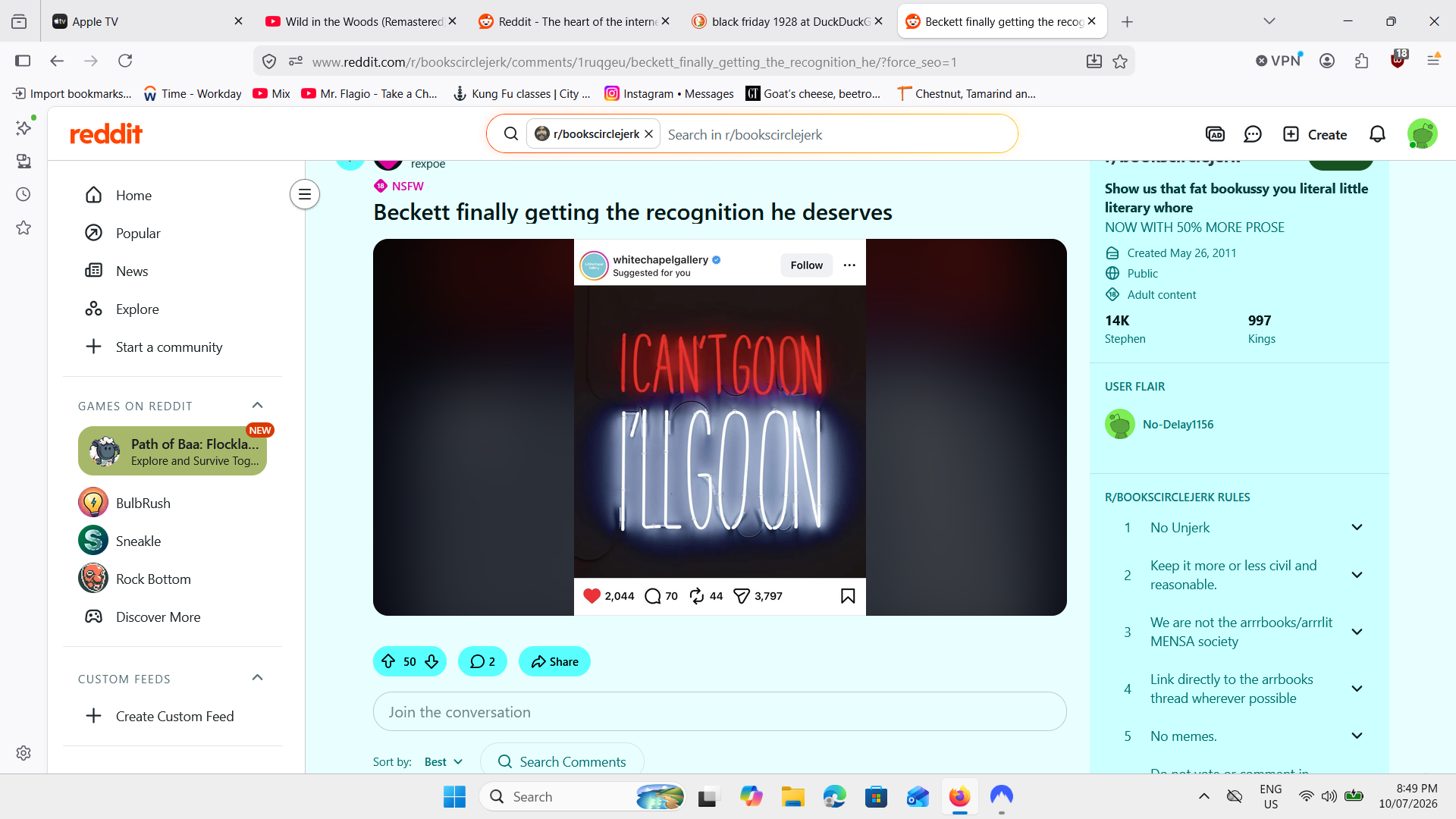
From the original post: “Alfredo Jaar ‘I Can’t Go On. I’ll Go On’ by Alfredo Jaar, is a neon work, created at a unique size for Whitechapel Gallery. It pairs a line from Samuel Beckett with the visual language of public signage…”
Beckett of failure, his entire ouevre: goon. Philosopher Catherine Malabou evokes in particular the plays of Samuel Beckett in speaking to the narrative of the neurological case study, speaking particularly to a form of “wakefulness without consciousness”, exhibited, sometimes, in those with traumatic brain injuries (tell me about it). “The theater of absence is the privileged expression of affective impoverishment and destructive metamorphosis. Its rhetoric comprises figures of interruption, pauses, caesuras—the blank spaces that emerge when the network of connections is shredded or when the circulation of energy is paralyzed. This theater is what Gilles Deleuze calls the theater of exhausted identity. Such identity is the possible born after the exhaustion of all possibles.”6 And so, there is something quite beautiful in this trajectory of bastardisation, where Beckett is so often taken out of context to become inspirational (which is utterly insane). I once presented a class of Masters of Architecture students with an example often touted by tech bros “Try again. Fail again. Fail Better.” Some four paragraphs later in the novella:
“ First the body. No. First the place. No. First both. Now either. Now the other. Sick of the either try the other. Sick of it back sick of the either.So on. Somehow on. Till sick of both. Throw up and go. Where neither. Till sick of there. Throw up and back. The body again. Where none. The place again. Where none.Try again. Fail again. Better again. Or better worse. Fail worse again. Still worse again. Till sick for good. Throw up for good. Go for good. Where neither for good. Good and all.“7
I was trying to get the point across that they were very unlikely to make anything approaching art in that one semester, because most of the work that people that call themselves artists produce is not art. Needless to say, I failed for good. But Beckett remains a balm, like the revenge of the broken psyche against the whole. Of course, in Alain Badiou’s reckoning, the subjection of his characters edges ever towards transcendance:
“Beckett’s writing attempts, at one and the same time, to speak unrepentantly of the stony ingratitude of the Earth, and to isolate, according to its proper density, that which exceeds it.
This is why we must begin with the beauty in the prose. It is this beauty that tells us what it is that Beckett wishes to save. This is because the destiny of beauty, and in particular of the beauty that Beckett aims at, is to separate. To separate appearance, which it both restores and obliterates, from the universal core of experience.”8
I also looked into the “community” of female gooners or “goonettes” (fucking hell), who inevitably cast their “lifestyle” as a positive engagement with porn that can also include going out into the world to live out porn fantasies through gloryholes, for one example (I can’t help but think that the advocates in the associated article hardly can represent all those who identify as such).9 This would seem to contrast with the expectations of the other gooner community, of incels in general. The “sex positivity” surrounding it would even preclude the kind of examination in something like the Steve Macqueen film Shame, where the protagonist, played by Michael Fassbender, is attractive enough to woman but trapped in a porn obsession and isolation. The corresponding goonette literature would rather be Ottessa Moshfegh’s My Year of Rest and Relaxation in which an independently wealthy commercial gallery worker drops out and drugs herself out of consciousness for the better part of a year (which has haunted me with its aspirational banality, as much as with Moshfegh’s literary collaborations with fashion houses). It is routine, and yet never ceases to be disappointing that existential horror is formulated in this society so as to apparently elude cis women, as though the only proper subject for feminism is positive representation. We can never be ugly and broken, ashamed, digusting, except in the eyes of internet trolls, for the “good people” we are only “mean” and “crazy”. When women began to be taught to read, in the vernacular, as opposed to a proper Latin/high Arabic/Literati tradition (etc., etc.), literature, as we know it, came to be. Jesuit priest and media theorist, Walter Ong, would argue that women “Styled themselves in a different, far less oratorical voice”,10 progenitors of this interiority. And only a few hundred years later it is all but lost to us, as patriarchal religion again mutilates the idea of what a man is in order to appropriate the miracle of creation (and thank god for that).
Of course, I imagine writing about gooning isn’t for me, the manosphere will be mad (boo hoo). Though, anyone looking to police the land of the gooner would do well to watch the YouTube series “Interior Motives”, where celebrities are shown the room of a person and asked to guess their age, gender, sexuality and location, and which essentially proves that all people are disgusting. I was particularly grossed out by a bedroom resembling the grimness of my own, with stacks of books I probably own i.e. Marx, Hegel, Thomas Bernhard, Lacan, overdubbed with Courtney Love’s repeated assertion that “this guy fucks” and “I would fuck this guy”, while the panel debated this anonymous person’s political leanings, because that bookshelf could be far right..? Someone needs to pay for the idiot effectiveness of Horseshoe theory. I digress. This happened without any of them questioning that “he” would have to be a straight man (to some extent fair given the lack of women’s clothes), with a “beautiful mind”.11 (I mean I probably just read that shit so that men will like me, right?) Though, I believe that the only thing said to have separated this particular room from “goon cave” was a lack of screens (I’m not sure who is really lacking in imagination in this scenario). Have I masturbated all day? Sure. (Sorry: TMI). But never with the requisite shame nor the requisite pride to be able to claim the title of gooner. Contemporaneously, transcendence, like existential dread, is unladylike (nevermind these things are almost inherent female traits). Gooning for and with the attention economy is trade coded. Nevertheless, I seem to understand and even feel in this description of “gooner” a somehow spiritual state of acute nihilism. It articulates something important to the moment, and to the impression of being valueless.
But what of the, somewhat related, pornification of beauty? In some Instagram reel a writer from the New Yorker, Jia Tolentino is quoted in having coined the term “Instagram face”12 to describe the filled and smoothed faces now augmented for optimisation on the app. In a more recent article “Our Plastic-Surgery Nightmare: As cosmetic procedures become both more invisible and more extreme, our connection to reality is fraying”13 this smug, middle-class doomer op-ed accepts current beauty standards at face value (no pun intended), writing of the capitalist imperative demanding these changes while lamenting that “the face is separating from the person, and the person is separating from the soul,” in what appears to be a contortionist act to avoid speaking to any structural material analysis. The two articles form a thesis basically asserting that the way that faces are augmenteed or re-formed via surgery is due to a standardisation that most find attractive, where a composite of a population will work out to be basically agreed to be beautiful, the beauty standard being said composite — basically white and Western, but with lip fillers thrown in. Of course, the population that is composited in these preferences is basically that of the United States, which is still predominately white (like, around 70%), and is famously exported around the globe, though by no means representative of it. And it is true that this methodology has been perfected by AI, and it is certainly creepy that a lot of it has been trained on porn (though Tolentino otherwise shies away from writing about that industry’s influence on beauty standards). The issue is that all of this is basically accepted as a foregone conclusion, where a computer-generated composite may represent a universal beauty standard, which is not necessarily the same as someone recognised as especially beautiful, at least before this end stage capitalism made us all aspire to standardisation for the sake of re-sale value, it is something very specific to this milieu. There is a very strange tacit acceptance of the standard, as though the technology actually represents an advancement in “beauty”. Those who study aesthetics will tend towards having very weird taste, which is a product of cultivation, where through looking at thousands of works, and doing even apparently unrelated research in dedication to the imperative towards art, will make one aware of minor deviations and references within works which will animate them with a knowledge that can only be communicated visually. I was recently awe-struck by Stephen Bram’s paintings at Sydney Gallery and was reminded why I like art so much. But it is sometimes easy to forget whilst we are collectively now supposed to have the taste of a teenage boy from a private school, doing high school art, because deep down we know that these are the only people who have a future in this society as long as we allow things to continue as they are.
The success of the Neoliberal era in degrading the importance of fields of understanding that are not immediately profitable has done civilisational damage. I made it pretty far into researching several different possible exgeses for my PhD, and while I was writing about the invention of the printing press and its relevancy to the change brought about by the internet, the next leap in logic was surely to write about the losses and gains surrounding the invention of the written word (lol). So I have really done my homework on the loss of literacy, and far from an alarmist, I had figured that new forms of understanding would take the place of the complex reading of scripts (where I mean for script to encapsulate alphabetic and calligraphic writing, as reading can obviously be used to describe all forms of information sharing)(language is hard). My assumption was that the divorcement from script would be accounted for in different forms of especially audio-visual literacy, which has long been my experience when surrounded by artists, and indeed my own experience of coping with neuroimmune disorder. But to my great surprise, it turns out that I have been a techno-optimist because the illiteracy absolutely extends to visual illiteracy. My description of the kind of art as asset, aspiring to be luxury good, currently being churned out through witless art faculties as a kind of porn slop, is probably counter-productive, and yet, there is a very real problem with a lot of the work being pushed by the institutions basically lacking the formal qualities that would have once been essential to “beauty”, through a focus rather on professionalism and a very warped sense of virtue through representation. In terms of local “feminist” art, the human form is either rendered exactly from technology to where it is truly naked, and not nude, essentially a corpse, as in a new sculpture by Nell on the Museum of Contemporarry Art Terrace:
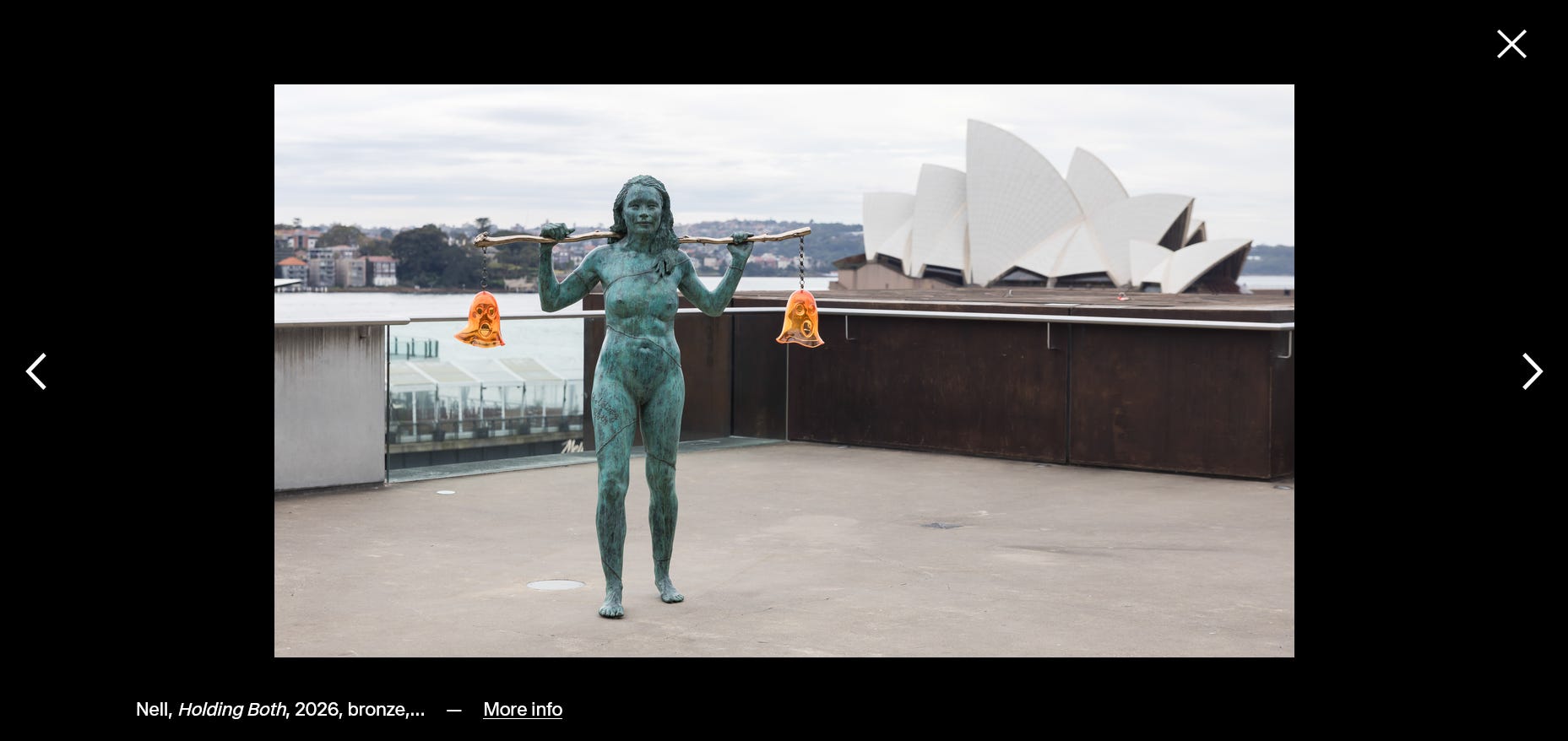
(I never thought I would so miss the affectation of a contrapposto stance) …or a heavily derivative (Matisse) and crudely rendered abstraction (which I write as someone that obviously likes crudity) that adds absolutely nothing to the sculptural continuum as in this work by Sanné Mestrom, entitled “What the body knows”, 2026:
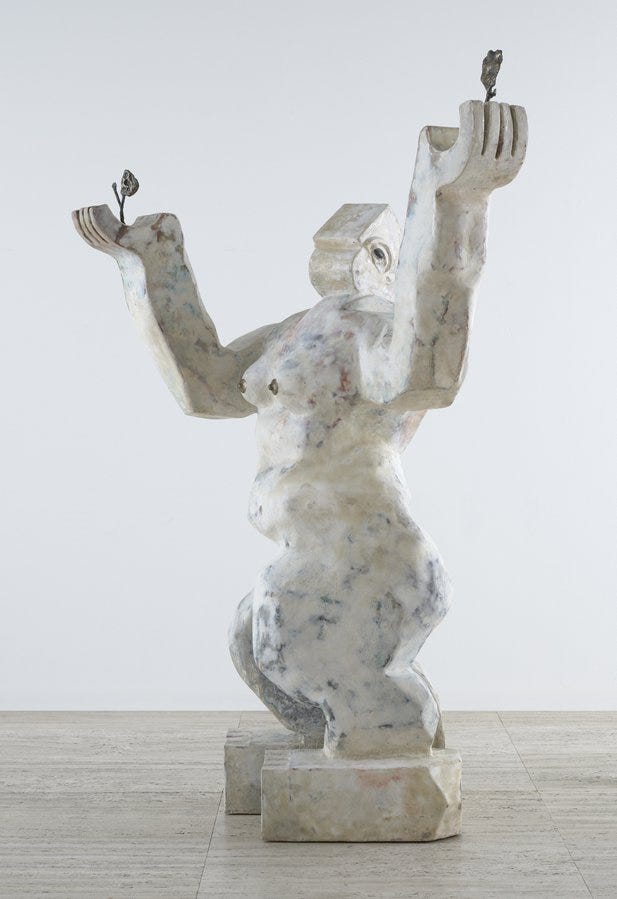
These forms of feminism suffer for failing in their perceived object of being representative, choosing rather to be representational. Also, I have never understood the repeated assertion that women representing the female form is inherently feminist, like it probably has to say something more than that. Even attempts to broaden the ideal of beauty generally fall short of Rubens. The inherent virtue is being signaled through how they are positioned, as reproductions of a privileged class, at a point in time when it is dangerous to do anything genuinely subversive. Because beauty isn’t just a slab of meat or a lazy repetition of the work of the great white man.
In the conclusion to the aforementioned article,14 Tolentino states “I occasionally feel the urge to reject modernity and embrace the religion of my childhood”. There are probably many issues I should have with articles of this nature that lament the inherent racism of the beauty standard but which demonstrate an incapacity to reject it (for fear of failing on an open market), but it is one throwaway line that gets under my skin. For the theological turn Tolentino takes is the aesthetic theory of Hegel: “It does not induce unhappiness and compulsion but makes desire withdraw, as Hegel put it, because the beautiful object is revealed as “inherently free and infinite,” “an end in itself”. Because somehow these plastic surgeries are of the material world, and so we must get away from the material world and see beauty as an expression of god’s truth? I actually can’t conceive of anything more masturbatory than this replacement of physical chemical attraction, of empirical beauty, and of art, with fucking Hegelian Idealism... like she would have us all gooning for god. (It should be noted that the aesthetic branch of philosophy has always made me almost irrationally furious.) It is also hilarious that where Marx famously turned Hegelian Idealism on its head with Materialism, a Liberal New Yorker writer now presumes to save Capitalism from itself by going with god, as some mirror to right wing discourse. (In fairness to Tolentino, she once caused outrage by talking about how she shoplifts on a podcast with Hasan Piker — deadset rebel.) Where the only motivation can be profit (extraction) capitalism turns all human endeavour into masturbation. If we are to abandon aesthetics to anachronistic studies of faith-based virtue or its bastard: market-based virtue, why not damn psychoanalysis similarly to the pre-modern confessional? And if capitalism is god, and it’s method of supplication the wankathon, then these gooners, these modern day anchorites, may as well be our spiritual advisors. Where there is the pathetic there is pathos. Embrace degradation, it may well be the first step to overturning these very material circumstances.
1 https://theworlddata.com/domestic-violence-statistics-in-australia/
2 https://www.abc.net.au/news/2025-06-18/nsw-four-charged-six-hour-sexual-assault-teenage-girl-liverpool/105429832, https://www.abc.net.au/news/2026-08-13/nsw-three-boys-charged-over-sexual-assault-girl-sydney/107034192
3 Julian of Norwich, Revelations of Divine Love, Chapter XXIV, https://www.ccel.org/ccel/julian/revelations.xi.i.html
4 Matthews, Thai-Catherine. “On the Margins of ‘Alle’: Feminist Theologies of Enclosure in Julian of Norwich and Harriet Jacobs.” Speculum (Cambridge) 99, no. 2 (April 2024): 331–57. https://doi.org/10.1086/729301.
5 https://harpers.org/archive/2025/11/the-goon-squad-daniel-kolitz-porn-masturbation-loneliness/
6 Malabou, Catherine. The New Wounded : From Neurosis to Brain Damage, Fordham University Press, 2012. ProQuest Ebook Central, http://ebookcentral.proquest.com/lib/usyd/detail.action?docID=3239638. Created from usyd on 2023-11-09 01:56:18. Xviii 55
7 I thought it was funnier to leave the hyperlink to the very academic source of some random Lyric generator site, which was for some reason the only version of Worstword Ho I could immediately get my hands on. Gratifyingly, since Beckett was his own translator, this is likely pulled from the only version.
8 Alain Badiou, On Beckett, Clinamen Press 2003, 44
9 https://www.inverse.com/input/culture/goonettes-gooning-women-porn-sex-addiction
10 Ong, Walter J. Orality and Literacy: 30th Anniversary Edition. 3rd ed. London: Taylor and Francis, 2013. https://doi.org/10.4324/9780203103258.
11
12 Jia Tolentino, “The Age of Instagram Face: How social media, FaceTune, and plastic surgery created a single, cyborgian look”, the New Yorker, December 12, 2019, https://www.newyorker.com/culture/decade-in-review/the-age-of-instagram-face
13 Jia Tolentino, “Our Plastic-Surgery Nightmare: As cosmetic procedures become both more invisible and more extreme, our connection to reality is fraying.”, The New Yorker, July 11, 2026, https://www.newyorker.com/culture/the-weekend-essay/our-plastic-surgery-nightmare
14 Tolentino, “Our Plastic surgery nightmare” ibid.
(Buy me a coffee link where you can literally buy me a coffee for this post if you have a mind to support, thanks!)
PART III: FASCIST FASHIONS
Doomscrolling Instagram the other week, I came across a name for something that I felt had long wanted articulation: The Great Male Renunciation, that point at which men ceased to adorn themselves in elaborate dress, in favour of more neutral fare. The idea was developed from the work of member of the Men’s Dress Reform Party in Britain in the 1930s, John Carl Flügel (who called the same phenomenon “The Great Masculine Renunciation”). Flügel, was, in fact, a notable psychologist, and someone who helped to popularise Sigmund Freud’s theory of the Oedipus concept, as well as the person who coined the term “homosocial”.1 The term “homosocial” has been used subsequently to explain the maintenance of male dominance in society, the “desire” within male relationships of at an at least ostensibly heterosexual nature. It is a good term to use in relation, also, to the not dissimilar “Looksmaxxing” movement, which I still haven’t really gotten to, but whose use of language, in particular, actually inspired this now unaccountably long text. One need look only at the veneration of idealised male bodies in the expression “mogged”, etymologically extended from “AMOG” or Alpha Male of the Group, to see historical parallels. They also run parallel in terms of white supremacist ideology very much couched in paranoia of “the other”. According to the Men’s Dress Reform Party: “(d)ress reform was necessary not only for the sake of enhancing masculine beauty, but also to prevent the further degeneration of the ‘British race’.”2 Flügel traced the origins of this turn to the the end of the 18th century, when tailoring became decidedly austere, “the occasion when men ‘abandoned their claim to be considered beautiful’ and ‘henceforth aimed at being only useful’”.3 (Oh, to live in a time when men were useful, lol.) The aspirations of said party were really quite modest, and generally concerned with introducing shorts, for example, where their only lasting impact was on leisurewear, and the introduction of skimpier men’s bathing suits. At a time when fashionable “flapper” styles spoke to women’s emancipation, certain groups of men had become envious of the comfort and freedom of these new styles, perceived as an extension of female suffrage and participation in a much broader range of professions following the The Sex Disqualification (Removal) Act of 1919.4 Dress Reformer and famed eugenicist Caleb Williams Saleeby was chair of the Sunlight League, which argued for greater sun exposure in a move towards cleaner air and general heathfulness, where this movement was also preoccupied by their insecurity over being mogged by the healthy natural bodies of the indigenous people they were then (and still are) colonising.5 Historian Joanna Bourke explains:
“Men were decidedly threatened. Just as men feared that they had become mere accessories to women, so, too, men’s clothing was said to have become simply a foil to women’s clothing. Men needed to become ‘as beautiful as women’. Male liberation was their catch-cry: it was time to do away with all symbols of masculine frustration.”6
The same men also feared the rise of the working classes, especially after World War I, tracing the origins of men’s dress to the French Revolution when aristocratic men had had to blend in or face the guillotine. This modern invention of masculinity as an extension of Enlightenment ideals like democracy, has often been said to account for this new and observable plainness in European men’s dress more broadly, and is often pointed to as a virtue, especially among members of the left who like to reduce the pleasure of adornment to the waste and frivolity of the fashion industry. Historian Chloe Chapin, however, places the genesis of this development in the time of the Glorious Revolution, and English Parliamentary Democracy, and it does seem, that rather than being a universal expression of Enlightenment, the trend is decidedly English. Because, prior to revolution, French fashions throughout the 18th century had remained colourful, often made with French silk, as Lyon had been the centre of European silk production since the Renaissance, made with “excessive fabric draped and patterned to fall over architectural understructures.”7 In fact, “Post-French Revolutionary fashions for dark woolen coats and riding boots, which replaced brightly-colored silk coats and stockings was known as “Anglomania,” the term itself pointing to the reality that this esthetically plainer fashion had already been popular in Britain.”8 Some of you will recognise “Anglomania” as the diffusion line of Vivienne Westwood, whose sensibility could be said to generally embody this level of intelligence. As noted by Chapin, historian David Kuchta “argued, the English aristocracy viewed the wearing of domestic woolen products as particularly symbolic of national pride and a matter of patronage since at least the Restoration, and understood silk (at least to some degree) as a foreign (and often feminized) import from the French.”9 Further than this, Kuchta undermines the notion that this turn is truly democratic, where the particularly English slurs regarding “effeminacy” were generally traded between aristocrats and the middle-class,10 as suffrage was always limited to these groups in the English model, and certainly neither wanted very much to do with the working class; the “Glorious Revolution” (1688), in which James II was deposed and the powers of Parliament enshrined, certainly excluded suffrage of the working class, women and members of the “colonies”11. (All of this will become weirdly relevant in my further examination of incel poetry, as we note this new codification of men’s dress as being practical, democratic and rational, as opposed to the feminine impractical, hierarchical and irrational, characteristics imposed on all “others” ever since.) In “The Making of the Self-Made Man 1750-1850” Kuchta examines the expansion as opposed to the rejection of the masculine ideal even by Radicals, following the Glorious Revolution, which, in turn, was adopted by the middle classes as a means to criticise both aristocrats and the working classes. Kuchta writes:
“In middle-class radical rhetoric, it was habits of consumption, rather than the relation to the means of production, that ultimately distinguished middle-class men from working-class men. It was middleclass men’s sober relation to the means of consumption— in contrast to the luxury and indulgence of both aristocrats and workers— that defined the middle class as a class.”12
Masculine forms of dress were also, of course, famously advanced by one Beau Brummell, credited as the inventor of the suit, in the early 19th century, and (for a time) close friend of then Prince Regent (and future King Charles IV), and influencer of democratic fashions that became essential to the aristocracy. Brummell was also friend of poet George Gordon Lord Byron, who, in his epic poem about a man travelling the world fucking wrote: “Man’s love is of man’s life a thing apart, ‘Tis woman’s whole existence.”13 Byron is often credited as the inventor of the “rockstar” mythologeme. Yeah.
There was, of course, changes and developments of this ideal along the way, and while it seems almost difficult to grasp now, that the aristocrats would have found ways to criticise the effeminacy of the middle-classes, it could be something that is seen to have resurgences throughout fashion and popular history in terms like “nouveau riche”, as well as even in the rather more contemporary phenomenon of “quiet luxury”. In this, we can now see a real fusion of gender identities within the upper classes, where feminine dress has become similarly muted, if we are to look to examples like the “viral” fashions of Gwyneth Paltrow in court. Paltrow is, of course, the poster child for “Liberal Z1onism” particularly in the form of being the spokesmodel for luxury apartments in Isr*el (whose parent company have developments in occupied territories), a position every bit as nonsensical as earlier “Dress Reform” eugenicists. The concluding chapter to Kuchta’s book, written in 2002, is, from this vantage point, somewhat amusingly titled “Inconspicuous Consumption”. The term “quiet luxury” seems to have become popularised along side the popular television series “Succession”, one of many, which, though critical of the machinations of empire, essentially valourise and place the spotlight on the ultra wealthy (it can sometimes seem like all television now surrounds the lives of the ultra rich as though to somehow make them interesting). In another American television series “Your Friends and Neighbours” the lead character, played by Jon Hamm explains in a voice over that the men are wearing almost identical shirts by Brunello Cucinelli, which a cursory internet search informs me retail for USD $1,150. I have processed these (boring, though well-made) shirts second hand and found myself wondering if their value expires by season, like a membership to an exclusive club, if you could have bought it second hand then how can you signal your extravagance? One might trace these origins to the Wall Street era of the 1980s, where men’s dress again became “masculinised” toward the suit as we understand it today after the gender experimentations of the 1970s, doubtless made possible by the Welfare State. The relaxation towards resortwear as well as luxury brand hoodies is, in effect, a continuation of the same rationalisation of fashion along class lines, the co-option of streetwear towards the consumption politic of the upper classes is another assertion of their robustness against the “effeminacy” of those forced to conform to uniform dress codes.
But, of course, “quiet luxury” is not the only game in town, and changing beauty standards for men are in no way localised to the extreme right, more classically “feminine styles” have been common on the red carpet for years now particularly through figures like Pedro Pascal and Alexander Skarsgård, because why not expand markets for beauty products and more elaborate costumes into new ideals of masculinity? The luxury market is no doubt perfectly capable of infinite variety. It is spectacularly unsurprising that it was the English that originally caused this perversion, where being attractive as a man became something “effiminate” in a way to distinguish the “democratic” from the wantonness of a literally disenfranchised working class. The Looksmaxxing and Men’s Dress Reform Movements may be seen as another fascist correction of the corruptions of liberal democracy, fascists love a return to feudalism, after all, and it is hilarious that they missed the memo when it came to “effeminacy” where both groups certainly hold women in no high regard. That said, your boring outfits and your disdain for anyone who enjoys dressing up, do not make you better than anyone else, just part of a long tradition of asserting your spurious superiority in an endless circle jerk of enfranchised masculinity. And you should all do your best to look pretty for me.
There is nothing inherently “fascist” or inherently “democratic” in any aesthetic, one of the great joys of aesthetic production is in subverting forms. And all forms of visual literacy are actually important, and it is so weird that it is becoming something so little appreciated in a society apparently obsessed by image. Capitalism created the fashion industry as we understand it, with industrialisation undermining millennia of literal cottage industry, clothing made for warmth, and love, and expression. The history of revolution (the Luddites etc.), as well as the history of computing are synonymous with the industrialisation of the textile industry, and yet an awareness of how fashion operates is still seen as stupid and effeminate, as though “effiminacy” is inherently a slur. My work in repurposing waste is just about as vital as I can think of as a thing to do by any metric, but I am treated and paid badly, and my “fashion sense” is dismissed as frivolty even when I put things together as I would in art. And I am tired of lazy men telling me what I should be interested in, while billionaires threaten my livelihood and give platforms to those who threaten my life. And denying the joys and the almost primal importance of adornment (as often the most central of creative urges) is utterly counterproductive.
1 Chapin, Chloe. “Masculine Renunciation or Rejection of the Feminine?: Revisiting J.C. Flügel’s Psychology of Clothes.” Fashion Theory (Abingdon) 26, no. 7 (November 2022): 983–1008. https://doi.org/10.1080/1362704X.2021.1952919. 986 and 989, respectively.
2 Joanna Bourke “The Great Male Renunciation: Men’s Dress Reform in Inter-war Britain”, Journal of Design History Vol. 9 No 1 O 1996, 23
3 Bourke, ibid.
4 Bourke, ibid. 24
5 ibid, 25
6 ibid, 24
7 Chapin, ibid. 996
8 ibid.
9 Ibid. The Restoration period was that subsequent to the English Civil War and the decapitation of King Charles I (1649), which introduced Parliamentary Democracy under Lord Protector Oliver Cromwell (and briefly, his son), until instability saw the return of Charles II from exile in 1660 (hence “Restoration”).
10 Kuchta, David. “The Making of the Self-Made Man 1750-1850” in The Three-Piece Suit and Modern Masculinity: England, 1550-1850, University of California Press, 2002. ProQuest Ebook Central, http://ebookcentral.proquest.com/lib/usyd/detail.action?docID=223407.
Created from usyd on 2026-08-29 04:47:55. 133-172
11 Suffrage was limited to property-owning men until the Reform Act of 1867.
12 Ibid, 142
13 In Don Juan, could not be arsed finding the correct page number etc.
(Buy me a coffee link where you can literally buy me a coffee for this post if you have a mind to support, thanks!)